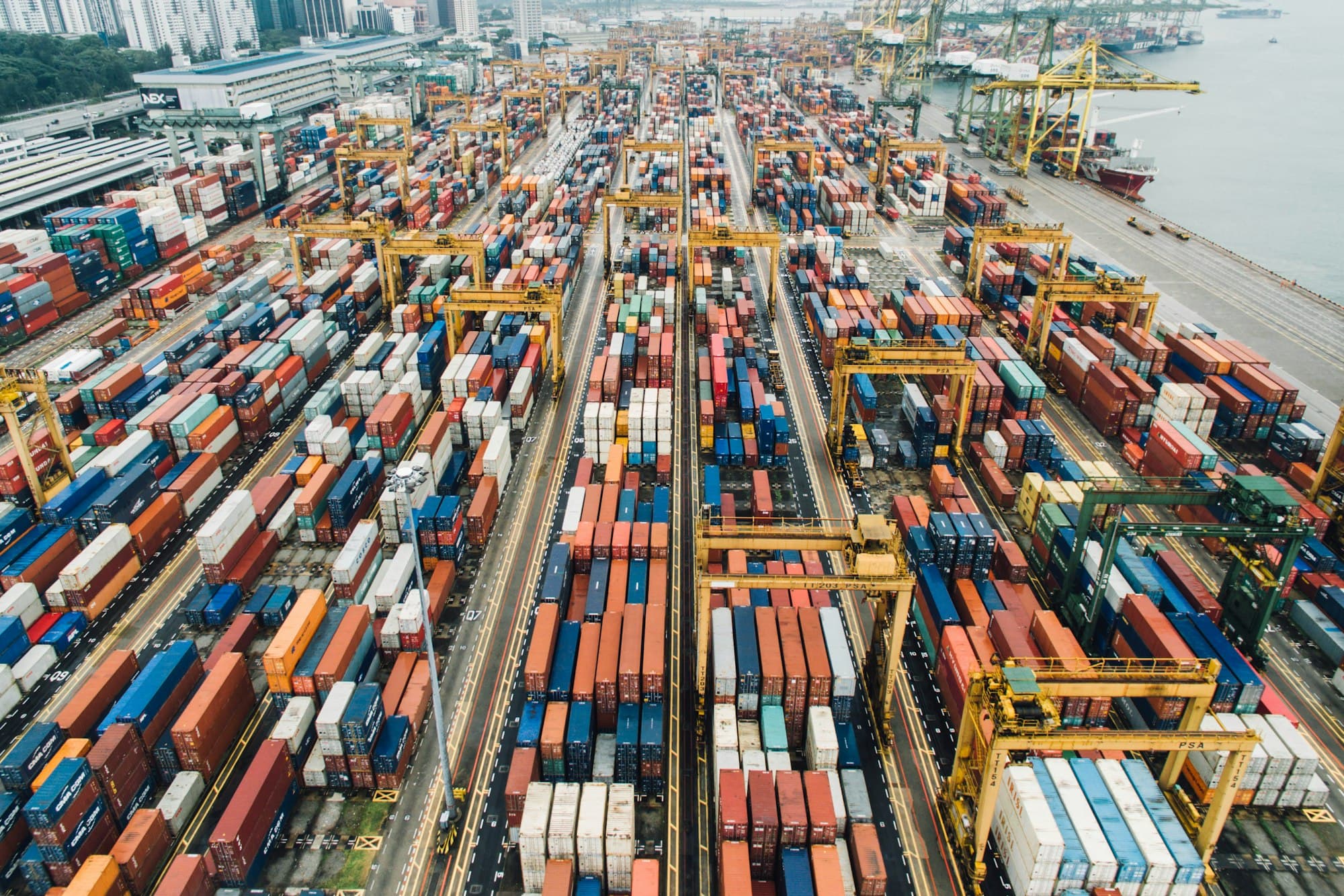
Short answer. Sea freight is the default choice for FMCG moving through Lagos: cheaper per kilogram, well understood by carriers, and matched to how retail and wholesale buyers actually plan inventory. Airfreight earns its cost when the cargo is high value, low volume, or genuinely time critical (launch samples, replenishment for a promotion that already started, perishables). For most consumer goods orders above one pallet, sea freight wins on total landed cost. This guide walks through the trade-off in the terms a Nigerian trade buyer or importer actually plans around.
When to pick each mode
| Factor | Sea freight | Airfreight |
|---|---|---|
| Cost per kg (typical, Lagos to Europe) | Lowest, roughly 10 to 20 times cheaper than air | Highest, but competitive on high-value low-weight cargo |
| Transit time, Lagos to major European ports | 18 to 28 days | 3 to 5 days |
| Transit time, Lagos to major Asian ports | 25 to 45 days | 4 to 7 days |
| Payload per unit | 20 ft (roughly 20 to 25 MT), 40 ft (roughly 24 to 28 MT) | Uplift limited by aircraft type and available space |
| Volumetric weight rules | Weight-based pricing | Volumetric weight often exceeds actual weight, raising cost |
| Common Incoterms | FOB, CFR, CIF, DAP | CPT, CIP, DAP, DDP |
| Documentation lead time | 7 to 14 days before vessel cutoff | 24 to 72 hours before uplift |
| Handling for fragile FMCG | Container consolidation, palletisation, dunnage | Less handling in transit, gentler ground time |
| Insurance premium | Lower per shipment value | Higher per shipment value |
| Environmental footprint | Roughly 10 to 40 times lower CO2 per tonne-km | Highest per tonne-km among common modes |
Source: public carrier schedules (Maersk, MSC, CMA CGM, Ethiopian Cargo, Emirates SkyCargo), IATA cargo statistics, IMO 2020 emissions comparisons. Please confirm current rates and schedules with your carrier at time of quote.
When sea freight is the right call
Pick sea freight when the following are all true:
- Volume is at least one full container or a viable share of a consolidation, roughly 3 cubic metres and above.
- Lead time allows 4 to 6 weeks from confirmed order to arrival at destination port.
- Shelf life on the goods is comfortably longer than the transit window plus customs clearance.
- Cost per unit matters more than shaving days off delivery.
For most Nigerian FMCG movements, wholesale food, beverages, household products, personal care, packaged consumer goods, sea freight fits every one of these boxes. Consolidation shipments (LCL) also let smaller buyers access sea rates without waiting for full container demand.
The paperwork sea freight needs
For an outbound sea freight consignment from Lagos, plan on a standard six-document pack:
- Commercial invoice
- Packing list
- Bill of lading (ocean B/L or seaway bill)
- Certificate of origin
- Phytosanitary certificate (for agricultural products) or health certificate (for food and personal care)
- NEPC documentation and Form NXP (Nigerian Export Promotion Council)
Additional documents may include fumigation certificate, quality analysis report, and destination-specific import permits. Lead time on the pack is typically 7 to 14 days before vessel cutoff.
When airfreight earns its cost
Airfreight is the right call for one of four cargo profiles:
- High value density. Personal care, cosmetics, and premium packaged goods where the airfreight premium is a small share of ex-factory cost.
- Time critical. Sample shipments, replenishment for a promotion already on shelf, launch stock for a fixed date, or contract commitments with a hard deadline.
- Perishable or temperature sensitive. Certain beverages, some personal care lines, and short-shelf-life food.
- Small residual volumes. Where cost of holding cargo for sea consolidation is greater than the airfreight uplift.
The paperwork airfreight needs
Airfreight documentation is broadly similar to sea, with airway bill (AWB) in place of bill of lading, and shipper's declaration for dangerous goods where applicable. Cutoff is much tighter: usually 24 to 72 hours before uplift.
Cost worked example
A worked example for a 500 kg parcel of packaged FMCG moving Lagos to Amsterdam:
- Sea freight (LCL): roughly USD 1.50 to USD 3.00 per kg, all-in landed at Rotterdam, before duty.
- Airfreight: roughly USD 4.50 to USD 8.50 per kg, all-in landed at Amsterdam Schiphol, before duty.
Rates fluctuate with fuel, carrier capacity, and seasonal demand (Q4 typically peaks). Request a live quote at time of shipment.
What buyers get wrong
Three recurring mistakes we see:
- Choosing airfreight to save on inventory holding cost when sea is well within lead time. The savings on holding cost rarely close the gap on freight cost.
- Assuming FOB is cheaper than CFR. For many first-time importers, CFR or CIF is cheaper on total landed cost because the exporter has better freight buying power at the origin port.
- Underestimating documentation cycle time. Late paperwork, not late cargo, is the most common reason a Lagos shipment misses vessel cutoff.
Frequently asked
How do I choose FCL vs LCL for a sea freight FMCG shipment? Full container (FCL) starts to make sense from roughly 12 to 15 cubic metres or 15 metric tonnes upward, depending on cargo. Below that, LCL consolidation is usually cheaper on total landed cost even after handling and destination charges.
Is airfreight faster on customs clearance as well as transit? Airfreight is faster on transit but not necessarily on customs. Destination clearance times depend on the country, the tariff category, and whether pre-arrival processing was filed. Some sea corridors with pre-clearance actually release cargo faster on arrival than uncleared air consignments.
Which is more reliable for peak season? Sea freight books up earlier for peak season (Q4 into Chinese New Year), so buyers who wait past September often struggle to get space at published rates. Airfreight is more flexible on short notice but at a premium.
What is the environmental impact of switching mode? Sea freight emits roughly 10 to 40 times less CO2 per tonne-km than airfreight, depending on aircraft type and vessel class. For buyers with scope 3 reporting commitments, mode switching from air to sea is one of the highest-impact levers in inbound logistics.
Where to go next
- Export logistics services from Nigeria: the full service overview
- Freight forwarding capability: sea, air, and land freight coordination
- Cargo consolidation capability: LCL and FCL consolidation
- Request a quote: send us your specification and destination for a written quote
Page last reviewed: 8 July 2026.