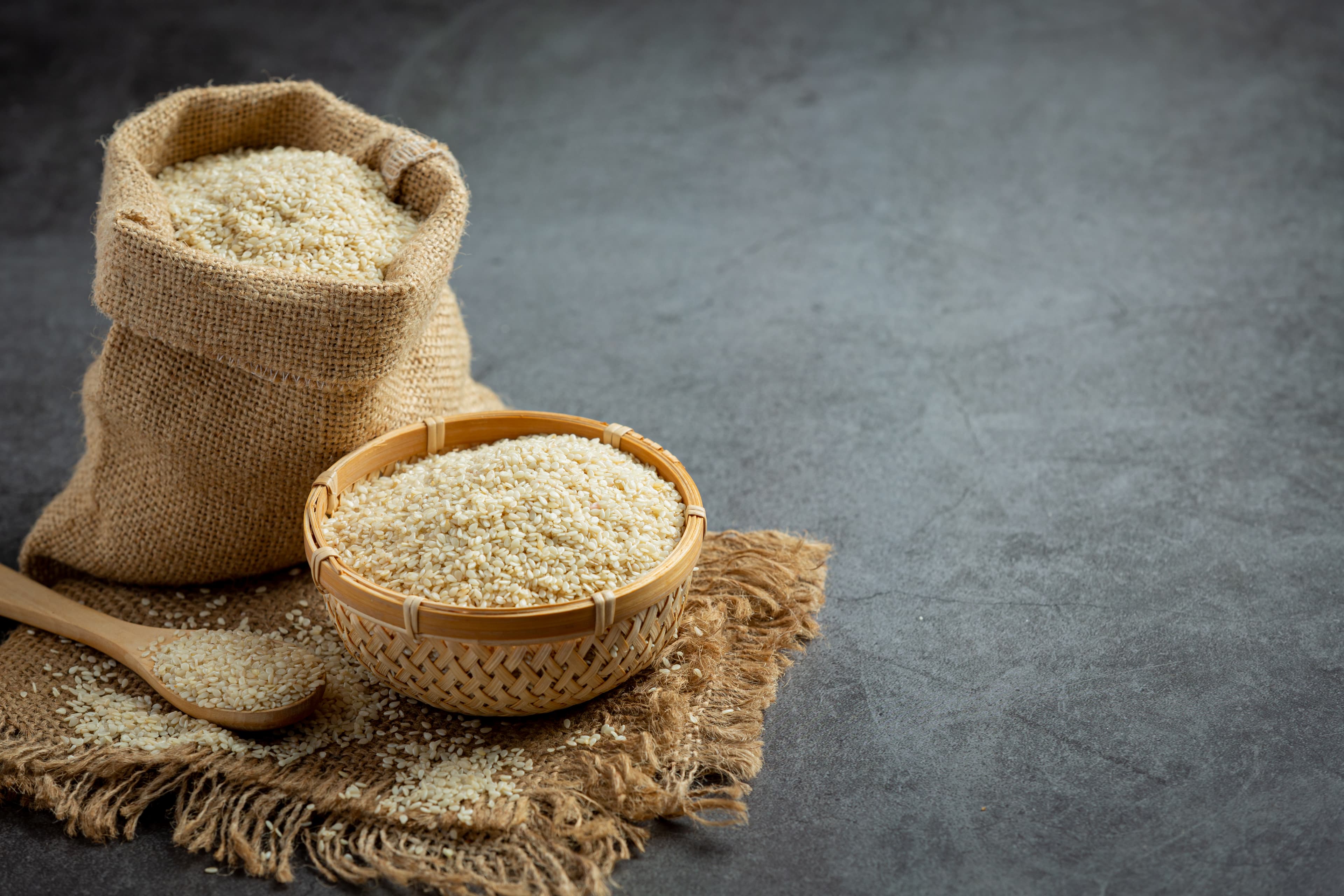
Short answer. Both origins ship large volumes of white sesame to international buyers, and both can meet confectionery, tahini, and oil pressing specifications. Nigerian sesame typically wins on oil content and price competitiveness for industrial buyers. Indian sesame typically wins on hulled sesame availability and more mature export processing infrastructure. Which origin fits depends on end use, spec, and budget. This guide compares the two on the terms procurement teams actually decide by.
At a glance
| Factor | Nigerian sesame | Indian sesame |
|---|---|---|
| Global export rank (volume) | Consistently top 3 (ITC Trade Map, HS 1207.40) | Consistently top 3, alternates first with Sudan and Nigeria |
| Growing belt | Northern Nigeria: Kano, Jigawa, Nasarawa, Benue | Gujarat, Rajasthan, Madhya Pradesh, Uttar Pradesh |
| Harvest season | November to February (main), June to July (second crop in some belts) | September to December (kharif), March to May (rabi in some belts) |
| Typical oil content | 48% to 52% | 45% to 50% |
| Typical FFA (Free Fatty Acid) | Max 2.0% | Max 2.0% |
| Common variety | Natural white sesame, hulled available | Natural white sesame, hulled widely available |
| Sortex cleaning | Available at loading, growing capacity | Widely available, mature capacity |
| Hulled sesame availability | Growing, quality varies by processor | Strong, mature processing base |
| Typical MOQ | 1 x 20 ft container (20 to 25 MT) | 1 x 20 ft container (15 to 20 MT depending on packaging) |
| Departure ports | Apapa, Tin Can Island (Lagos) | Mundra, Nhava Sheva, Kandla |
| Transit time to China | 25 to 35 days | 15 to 25 days |
| Transit time to Europe | 18 to 28 days | 20 to 30 days |
| Transit time to Middle East | 12 to 18 days | 6 to 12 days |
| Typical FOB pricing (industrial grade, USD per MT) | Historically 5% to 15% below Indian equivalent grade | Historically the reference price for the industrial market |
Source: ITC Trade Map, industry buyer surveys, exporter loading records. Prices and transit times fluctuate with harvest, currency, and freight rates. Please confirm at time of quote.
Where Nigerian sesame wins
- Oil content for oil pressing buyers. Northern Nigerian belts consistently produce lots at the top of the 48 to 52% oil content band, which is what tahini, halva, and oil pressing buyers pay a premium for.
- Price on industrial and natural grades. For natural (unhulled) sesame moving into industrial food, oil pressing, and bakery ingredient use, Nigerian origin has historically priced 5 to 15% below Indian equivalent grades.
- Direct farmer network. Sourcing directly from the harvest belt (as opposed to layered middlemen) keeps admixture and quality more traceable.
- FOB Lagos to European ports. Sea freight from Lagos to Rotterdam, Hamburg, or Antwerp is competitive on both time and cost.
Where Indian sesame wins
- Hulled sesame capacity. India's mature processing base means sortex, hulling, and re-hulling capacity is more consistent, especially for confectionery-grade hulled requirements.
- Faster transit to Asia and Middle East. For buyers in China, Japan, UAE, or Israel, Indian ports are geographically closer, meaning shorter transit and lower ocean freight per MT.
- Wider spec bandwidth. More mills means more variety of grades at any given time.
Which fits which end use
- Tahini and halva producers: Nigerian origin for the oil content, Indian origin when hulled specification is tight.
- Confectionery bakers (hulled, sortex): Indian origin typically has an edge on consistency at scale, though Nigerian sortex capacity is closing.
- Sesame oil pressers: Nigerian origin for oil yield.
- Industrial food processors: Either, priced on total landed cost including freight to your destination.
- Retail packers and private label: Both origins, chosen on brand story and margin.
What both origins need to prove to buyers
Origin choice does not remove the need for specification discipline. Buyers still need:
- Signed contract with explicit grade, moisture, FFA, oil content, and admixture limits.
- Pre-shipment inspection report and loading photographs before the container leaves the port.
- Third party inspection (SGS, Cotecna, Bureau Veritas) when the contract calls for it.
- Documentation pack matched to destination: commercial invoice, packing list, bill of lading, certificate of origin, phytosanitary certificate, and any import permits.
Common misconceptions
- "Origin decides quality." Origin sets an upper bound. What ships to your warehouse is decided by contract discipline, inspection, and the exporter's process, not the country stamp on the certificate of origin.
- "Indian sesame is always cheaper." For industrial grades and destinations closer to Lagos, Nigerian FOB pricing is often lower on total landed cost.
- "Nigerian export documentation is slower." Documentation cycle times for Nigerian sesame are within the same band as Indian, provided the exporter files early and the phytosanitary process is started ahead of vessel cutoff.
Frequently asked
What is the minimum order quantity for Nigerian sesame? Our standard minimum is one 20 ft container, roughly 20 to 25 metric tonnes depending on packaging. Smaller LCL shipments are possible against a confirmed contract.
Can you supply hulled sesame from Nigeria? Yes. Hulled sesame is available, sortex cleaned and hulled to the buyer's specification. Contracts typically confirm hulling grade and sortex level before loading.
How long does a shipment take from Nigeria? From confirmed contract to bill of lading is typically 3 to 5 weeks. Vessel schedules and destination transit are on top of that.
Do you offer origin blends? No. Contracts are single-origin. Buyers who want split-origin coverage typically place separate contracts, one Nigerian and one Indian, through their respective exporters.
How do I compare a Nigerian offer to an Indian offer? Match specifications (moisture, FFA, oil content, admixture, purity, sortex level), Incoterm (FOB, CFR, CIF), and destination port. Total landed cost per MT (freight + duty + insurance + inland to warehouse) is the number that matters, not the ex-origin FOB alone.
Where to go next
- Nigerian sesame seeds product page: specifications, packaging, and destinations
- Agricultural exports overview: the full commodity range
- Request a quote: send us specification and destination for a written offer
Page last reviewed: 8 July 2026.